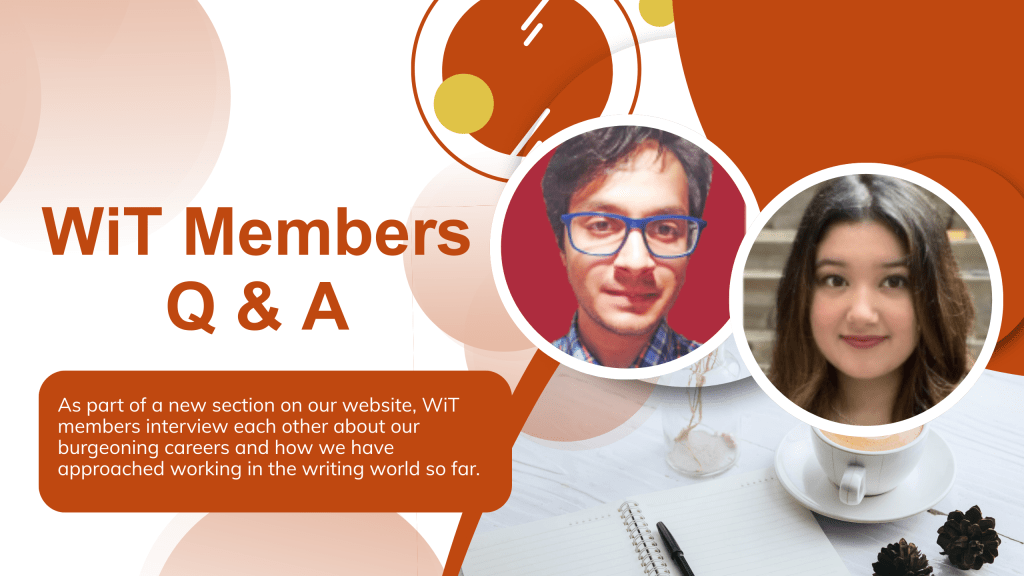
In this interview, Paavan asks Emma how she has navigated her career so far, what made her choose publishing, the experience she has gained and what advice she has for people wanting to work in this world.
Hi Emma! My first question, so that we can start at the beginning, is: what made you want to work in publishing? What did you study in university and when did you realize what career path you wanted to follow?
I studied English at university, which was a decision that stemmed mostly just from loving the classes I took. Publishing started to pique my interest a couple years into my degree, when I realized that it could be a natural career path for my interests and my degree. My interest in publishing crystallized when I met our wonderful mentor Ann through the U of T job shadowing program. She had a prior career in publishing, and she also talked about what it was like to work with publishing companies from the author’s side of things! Everything sounded so interesting to me, and I knew I wanted to learn more.
How did you enter the publishing world? What was your first job in publishing and how did you prepare for it?
One thing I did when I committed to learning more about the publishing world in Canada/Toronto, was looking at (I’m sorry for the jumpscare everyone) LinkedIn. I took a look at local publishing industry professionals, and tried to see what routes they had taken to break into the publishing industry. It became clear that many of them had taken courses for the Publishing Certificate at Toronto Metropolitan University, so I checked that out! After attending an online Q&A seminar which discussed enrolling in the certificate, the classes, etc., I decided that the certificate would be a good start. The thing about a “general” degree like English, is that you learn broad skills. This can be great in the long-term, because so many jobs will benefit from you having analytical, critical thinking, and communication skills. But it also doesn’t funnel directly into any one career. With the Publishing Certificate, the steps became very clear to me.
What was your experience with the publishing certificate?
The courses were useful because, as I said, it was really helpful to get direct and hands-on advice. Every course is tailored to the Publishing industry specifically, so it is a great option if that is your goal! It was also nice to be immersed in a (virtual) community of people who were also trying to break into the publishing industry. However, I don’t want to make it sound like everybody needs to take courses in the certificate like I did. I have also heard of people leveraging past experience working in bookstores and as book influencers/bloggers to break into publishing! This is just how I did it, based on seeing that it was a common road people took! I decided I would take the classes until I felt comfortable enough to try my hand at a Publishing internship. My first job in the publishing industry was a Marketing and Publicity internship.
What was the application process for the internship? What did you learn there?
I believe, for students enrolled in the Publishing Certificate, the general recommendation was to start earnestly applying to internships after you had completed 3-4 classes in the certificate, but the truth is that you can always apply. Indeed, the act of applying to publishing internships is educational in and of itself! I’m going to be honest here: securing a publishing internship can be a bit of a long-term process. They tend to receive a lot of applications, and often from many people with very similar credentials (we all love reading and writing, we all love books they’ve published, and many of us are taking Publishing Certificate courses). To stand out can be a bit difficult, and my advice here certainly isn’t one size fits all. At the end of the day, I know it can be annoying to hear this over and over, but the truth is that networking was very important to me finding my publishing internship. When I was finally able to secure a publishing internship, it was because I was introduced to somebody who worked at the company by a fellow Writers in Trees member. Speaking to this (amazing) person really helped me to tailor my application to the needs of that internship, and I’m sure it also helped me to stand out as a known commodity of sorts in the initial application screening process. There you have it! So much of it is luck, and knowing somebody who can talk you through more specific details. I’m endlessly grateful to everyone who helped me to find my internship, because I did not in any way do it alone. You know who you are! ❤
I find it interesting that you did not complete the full certificate but were instead strategic about which courses you took, because while I was pursuing the certificate, I met people who felt like they were not ready or confident enough in their skills or experience to apply to work in publishing until they had taken all the courses they could and graduated. That seemed unnecessary to me.
Well, I know that what I did might not be for everyone! When I got to the internship, I found that quite a few other people working in the industry had done the same thing, which is a big part of what drove that decision. As much as I love school and taking courses (I really do), it is a not-insignificant financial investment. By the time I had finished my internship, I had both taken courses in the fields of publishing that I was interested in and gained hand-on experience. I wanted to focus more on what I wanted to try next from a career perspective, even if that wasn’t something 100% classically within the publishing world. I also knew that I could return to the courses to finish the program if I wanted.
You are working in audiobooks now, is that correct? What is your role now and how are you finding it?
I am! My current role is focused on Marketing Curation. My favourite part of my job is creating booklists for different topics and genres. I’m fairly new at my current role, but I’m completely loving it. Interestingly, though I’m still working with books, I am not working at a publishing house! So, in that way, I suppose this proves my point that there are jobs that could appeal to those who love publishing that aren’t “classic” publishing jobs! If there are any takeaways from this interview, that could be one of them. I just think that it can be helpful for people to know that there are other avenues to work in books and with the written (or even spoken) word.
I want you to know that what interests you in publishing might, in fact, also exist in other related industries. So, if you feel super stuck at the internship starting gate, it could be helpful to look to all these related industries. Either way, I wish you (dear reader) all the best of luck in your passion and career pursuits! Your voice is unique, and I hope to hear it out there in the world! Whether that is in books, copy, captions, or any other medium!
Thank you so much, Emma. I think you’ve said so much here that people will find immensely helpful.
Paavan Agarwal is a writer and editor. Currently an editor working in India, he studied English and physics at the University of Toronto. He is interested in modernism, postmodernism, and postcolonial writing. He is passionate about form, but also content. He loves trying to help others’ work reach its full potential, as well as his own. He is currently working on two speculative fiction stories and editing a third. He loves to do photography and watch movies in his free time and has many unsolicited recommendations.
Emma Graham is a graduate of the University of Toronto’s English Specialist program. Emma has contributed to the Campus Co-Op monthly newsletter and also participated in a Work Study program during her undergraduate studies. During that time, she assisted in compiling research for, and editing, chapters of a now published sociology textbook. She also has significant experience writing technical copywriting to increase SEO for digital marketing purposes. Additionally, she served on numerous boards and meeting-based groups throughout undergrad, including but not limited to: The Campus Co-Op board, as Scholarship Chair for her sorority, and on her Residence House Council.
 Writers In Trees