By Tali Voron-Leiderman
This talk was delivered during the virtual launch of the Forest Floor anthology. It has been edited for online publication.
It takes a village to make a book. The Forest Floor anthology took two years of hard work, dedication, writing and rewriting, plotting, planning and designing, editing, editing again, and then proofing once more for good measure, strategizing, launch planning, social media posting and audience building, the list goes on and on and on. But here we are, gathered together, to celebrate the creation of a beautiful book that started off, as most things do, as just an idea.
It was a gift to be invited into the Writers in Trees to demystify what it means to publish, and to be offered a front row seat into what a dedicated and ambitious group of writers can accomplish when they pool their skills, talents, and interests.
Paavan, John, Leah, Emma, Chelsea, Santhwana, Rahma, Tracy, Lauren, Vanessa, and Nicholas, your tireless efforts, hard work, creativity, and commitment to learning every facet of publishing to produce this anthology is admirable, and an undeniable success. Ann, your brilliance shines through and uplifts every individual and project you encounter. You embody what it means to wholeheartedly engage in, and prioritize, community. Community is what we build through sharing stories, and what is fostered through connection. And so, I would like to spend our time here together thinking about the necessity of community and collaboration in book publishing.
Let’s break down the publishing process into its core components. First, we need the creative work. The words. The heart of the thing. We tend to think of writing as an isolated act. Inspiration can come from anywhere, but most often from the way we engage with the world and with each other. We seek solace, comfort, support, in points of connection. Even if not a word of your work is shared or read aloud, talking it through, writing and revising, iterating, often cannot be done without the influence of someone else. A project like Forest Floor necessitates collaboration. A unifying theme was settled upon. There was agreement about the kinds of work that would be crafted or revised, as well as the parameters and scope that each piece would need to adhere to. The collected works in this anthology were selected with care, intended specifically for the purpose of this collection. This body of work wouldn’t exist without the thoughtful collaboration of the collective creating a home for each short story, poem, and essay found in the pages of Forest Floor.
Once the writing is completed, we move on to the next stage of the publishing process. Editing. Editing is a partnership. An act of trust. Allowing someone into your work is intimate. To offer suggestions for improvement. To fix more than an extra letter or a missing comma. Editing is essential and laborious, spanning hours – often days, weeks, and months of back and forth. It requires vulnerability from the writer and a clear vision from the editor. It also demands mutual respect from both parties, and a shared desire to serve the work at hand. This perspective, and step, cannot be understated or missed. The careful hand of the editor offers the possibility of transforming a text so it is no longer just for the writer, but so it can be best received and understood by the reader, culminating in an essential partnership at the core of the publishing process.
Once the words have settled, we turn our attention to design and aesthetics. We all know the saying “Don’t judge a book by its cover”, but often we do. Our attention is captured by book covers with striking designs that make us feel something, that invite us into the world of the book. The cover of Forest Floor is captivating. A black and white image of a blossoming tree with roots that dig deep into the ground behind a hand reaching upwards. It’s a powerful visual, evocative because of the meaning behind the layered symbols and the contrast of the colour palette. Its design immediately leaves readers curious, intrigued, and wanting more. The interior of the Forest Floor anthology is deliberate too. Fonts are carefully selected, the spacing of words on the page, the choice of margins. Every decision leaves its mark on the reader’s experience. Good design requires skill and an artistic eye. Working with a designer is also a relationship built on trust and clear communication, thoughtful back and forth, as an art object is actualized through laying out words and images on the page. Book design frames the entire reading experience from cover to cover –online and in print– and must be acknowledged as such.
Once the book has been edited, layed out and designed, printed and bound or prepared for digital distribution, all efforts turn outward. It’s time to build an audience and raise awareness about the book. Building a social media presence, creating a website and building a brand, organizing launch events, attending festivals and reading series, participating in panels and talks, receiving book reviews, each initiative plays a part in building the platform and recognition of a book along with its authors. It’s a challenging task to move from the role of a writer, working inwardly and independently, to shifting focus to engage with the public on all fronts. It’s a privilege to be able to engage with the work of a writer on the page, and then to have the opportunity to engage with the writer themselves. It’s a demanding task, and yet, it’s moments like these where the magic happens. Where a connection is fostered through story. And here, readers and fellow writers are asked to rise to the challenge and show up for authors and their works in all the spaces they make themselves available. It is the act of showing up– participating, reading, buying or borrowing books– that makes all this work.
It takes engaged and dedicated literary citizenship to ensure that the books that we publish have a life that extends long after the day of its release. Books are not meant to exist in isolation; they are meant to be read, shared, passed on, scribbled in and loved. Forest Floor will receive this warm reception and will continue to leave its mark long after today, because of each of you here. As soon as a book is in your hands – or on your screen – you become part of the story. You ascribe meaning to the words printed on the pages. Your thoughtful interpretations and connections will mold the text into an experience enjoyed exclusively by you.
When you recommend a book – through an excited exclamation to a friend or family member, through a book review published on Good Reads or in a literary magazine, through gifting a title you know a loved one will enjoy – you ensure that the story finds an audience. You are spreading the word. If you love a book, find a way to connect with the author. Remember that someone once sat and poured their heart onto blank pages long before the final product now in your hands was ever a certainty. Recognize the creative practice, dedication, and grit that goes into creating a book. Acknowledge the many people, layers, stages, that go into bringing this book into the world. Remember that you only see the final product that took yearsand a range of skills, an entire team, to put together.
Storytelling is innately human. We pass down knowledge and wisdom. We create. We channel our creativity. We tell stories to connect and to be connected. This cannot and will not exist without collaboration and community. Whether you are a writer, a meticulous editor, a book designer, a fearless marketer, a persuasive bookseller, or perhaps (and maybe most importantly) an avid reader with a deep love for good writing, we all play a part in the creative ecosystem.
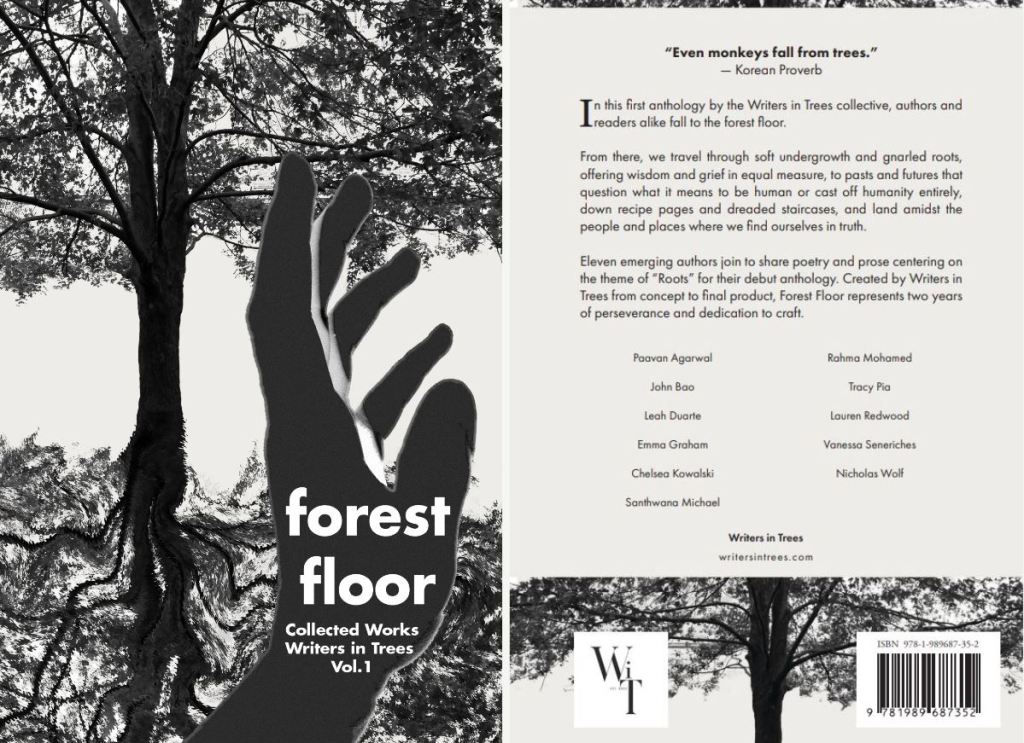
Our stories don’t exist without partnership and collaboration; we always need stories to be told and someone to listen. Our stories are at their best when they are workshopped and shaped, carried gently and spread widely, amongst and between a sea of excited, helpful, willing, and generous humans that believe in the power of the written word. As we celebrate the anticipated release of the Forest Floor anthology, let’s also celebrate the 11 authors who not only told their stories, but who worked diligently to edit, design, market, and make available this remarkable collection. We are also given the gift, and the opportunity, to soak up the craft of the Writers in Trees collective, and then make sure we each do our part to ensure that this book is shared and spoken about long after today.
Tali Voron-Leiderman is the managing editor of The Ampersand Review of Writing & Publishing and teaches in the Honours Bachelor of Creative Writing & Publishing at Sheridan College. Tali was the founder and publisher at The Soap Box Press and is the founder and managing editor at Plume Press. She holds an Honours Bachelor of Arts from the University of Toronto where she majored in English, and completed her Master of Arts in Literatures of Modernity at Toronto Metropolitan University.
The views and opinions expressed in blog posts are those of the authors and do not necessarily reflect the views or positions of all WiT members.

