By Chelsea Kowalski
There’s a well-known story about the origins of To Kill A Mockingbird by Harper Lee that is something of a writer’s fantasy. Lee was working customer service jobs in New York and publishing short stories on the side in 1956. She managed to get a literary agent (no small feat!) and one month later, her friends gifted her enough money to cover her expenses for a year with a note: “You have one year off from your job to write whatever you please. Merry Christmas.”
I think most writers (and most people) dream about the ability to take a year away from their job or indulge their art without the pressure of financial obligations. For Lee, that year ended up with To Kill A Mockingbird, which cemented and skyrocketed her career as a writer. Authors who make it big like Lee are often seen as an exception or an anomaly. And the gift from her friends seems even more rare, especially in today’s current economy. But if we could take a year off, what would we do with it?
What if every writer really did quit their day jobs, lived off of savings or gifts for an entire year and just wrote? How many of us would create To Kill A Mockingbird? How many of us would try? How many of us would consider it a failure if we couldn’t?
It took Lee less than six months to come up with her manuscript. It was sent off to publishers, won the Pulitzer Prize for Fiction, and the rest is history.
Except it wasn’t that simple or easy.
Lee’s first manuscript was originally titled Go Set a Watchman and it went into the hands of Tay Hohoff, an editor for J.B. Lippincott Company. Hohoff considered it to be more anecdotes than novel and didn’t publish it. Instead, she and Lee worked on it together for two years, making revisions and changes with endless discussions over minor details. Lee even once threw her own manuscript out of a window out of frustration.
It’s not supposed to be easy. The potential of difficulty and frustration isn’t supposed to keep you from trying. There are enough obstacles already, like time and money. And even if you could remove them, like Lee’s friends did, there’s still the fear of failure, the pitfalls of the publishing industry, the saturation of certain genres, etc. And no matter how much your friends can cover, until the best-seller is out, you will always need more money.
I’m not sure what Lee did to cover her expenses after that first year, but I can imagine it wasn’t the gift or the free time that fueled her to continue on in the editing stage. It was the faith in what she had written. Her friends started that faith when they gave her the gift of a year off. And for Lee, it paid tenfold.
Many writers are fortunate enough to have a community behind them, whether it’s friends, family, partners, other writers, readers, etc. What if we looked at our writing through their eyes? What if we treasured it for what it could be?
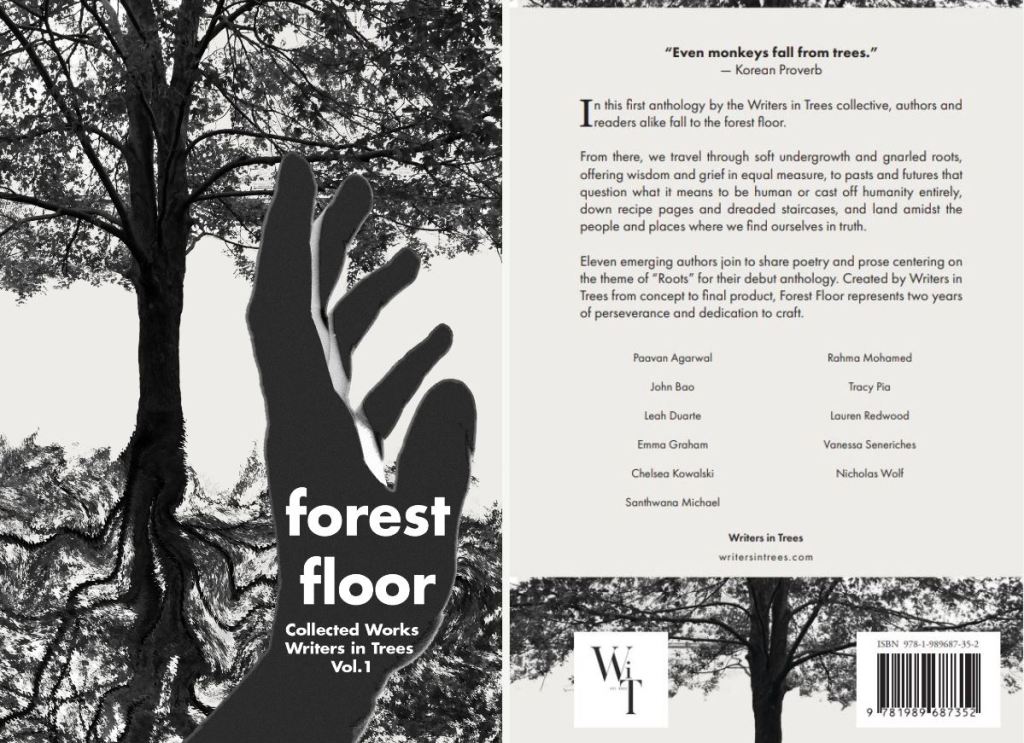
I participated and read at my first book launch for the Forest Floor anthology by the Writers in Trees members. I was prepared for a few “good luck” cheers and a couple familiar faces in attendance. But the response I received was overwhelming. I had friends reaching out to me, asking for a link to the anthology. Writers I had never met were quoting my own lines to me and praising my work. A few people have asked when I’ll do an in-person reading. A few more have asked when the next anthology comes out.
I received a level of support from my community that I thought would come only once I achieved commercial publishing success, not before. And that gave me renewed faith and motivation for my writing. Undoubtedly, a gift. The only question from here: what will I do with it?
Chelsea Kowalski is a reader, writer, and editor. She has edited both fiction and non-fiction pieces for magazines, novels, and published essays. Chelsea is an alumna from both the University of Toronto and Toronto Metropolitan University, completing programs in English, Creative Writing, and Publishing. She is passionate about all things literary (especially female-driven books) and loves interviewing new authors about their unique stories. Chelsea is happiest when given the chance to write, edit, and help support someone’s dream of reaching readers.
Read Chelsea’s post, Five Tips for Aspiring Writers (From an Aspiring Writer!)
The views and opinions expressed in blog posts are those of the authors and do not necessarily reflect the views or positions of all WiT members.
 Writers In Trees