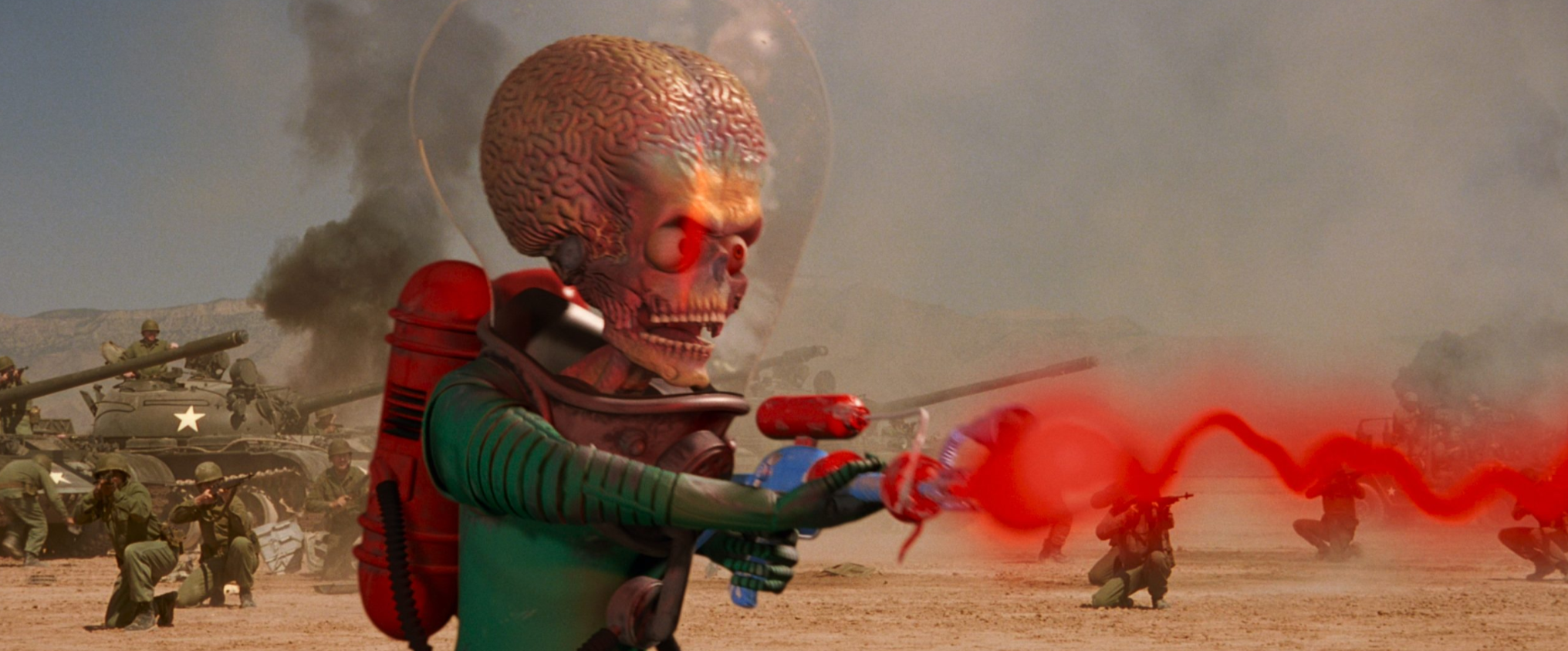
My relationship with the concept of aliens began with seeing Tim Burton’s Mars Attacks! on a hotel TV with my family late one night when I was seven and we were on vacation. There is a moment where a hippie releases a dove in celebration of the Martians declaring that they have come in peace. The Martians take one look at the dove and pull out their laser guns and blast it to oblivion; it falls to the ground as a deep-fried skeleton. Then, they proceed to do that to every human being present. As an adult, it’s a pretty funny movie, but seeing that dove and those people get turned into skeletons was quite traumatizing for me as a child, the irrational aggression of the act. Still, I watched the whole movie that night, pretending to be asleep, mesmerized by the a-hole Martians. For the rest of the vacation, I would see spiky fruits on the ground and think they were alien pods which had come down and would open and reveal invaders at any moment. I was pretty worked up about it, privately. The Bollywood movie Koi… Mil Gaya the following year, did not help things either. At night in bed, I would think the reflections of cars on the underside of our AC were UFOs descending.
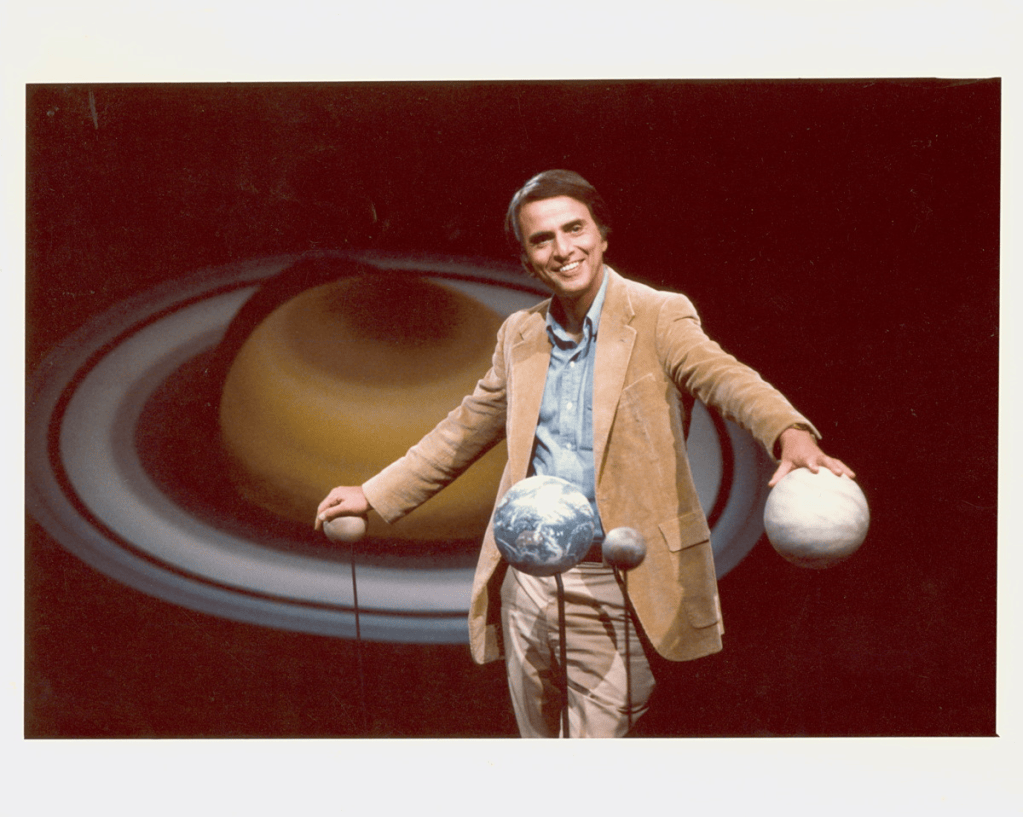
Just two years later, a switch flipped, and suddenly I was obsessed with aliens. The Spielberg film War of the Worlds came out and I read the novel and then watched the movie at home glued to the screen, agog and enthralled by its apocalyptic imagery. Then, like many young people before us, my friends and I sought out the Mysteries of the Unknown collection in our library and we learned the pop history of Roswell, flying saucers, Bigfoot, the Chupacabra, and all those other fun, kooky things. As I entered adolescence, I also joined our school’s astronomy club, and we went on an overnight trip where the darkness made us see all sorts of things, including UFOs. Very creepy, in the moment, but fun. I tried to watch all the movies and read all the books on the subject of aliens, and science fiction in general. I also began to read Carl Sagan and became a serious fan of Cosmos and all his other books, and of the Sagan standard “Extraordinary claims require extraordinary evidence” which is something that guides me to this day.
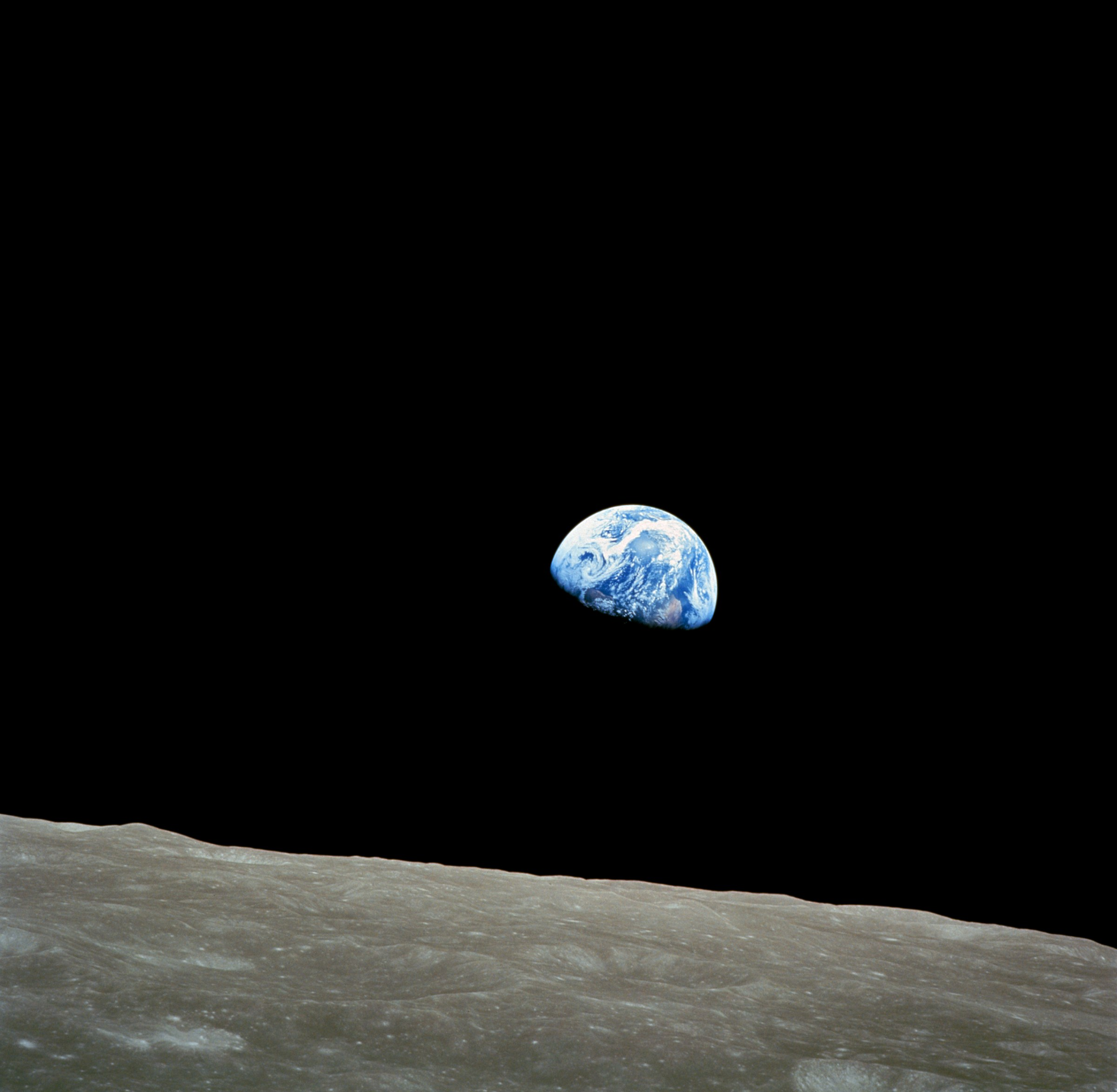
I should tell you now that I do not believe in aliens. Or, let me put it another way; I do not think that aliens are an interesting or worthwhile thing to believe in, although it can be a fun subject to talk about with friends at parties (although my contribution to these conversations is a bit of a party pooper, as you’ll see). I have studied enough astronomy and science to know that the creation of life on Earth was a stunningly unlikely event, permitted by factors such as the distance of Earth from the sun, the fact that Jupiter’s gravity protects Earth from most of the asteroids headed towards it, and a billion other variables, all of which led to the miracle of life on Earth, intelligent or otherwise. There may as well be life in the universe, or even in our galaxy (it’s a big place), but due to the absolutely staggeringly large distances and infinitesimal probabilities involved and the limitation of the speed of light, they are probably so far away that we will never meet or hear them and they may as well not exist. In any case, it makes no sense to sit around and wait for that to happen. When I said all of this to my Trekkie friend I could see their face fall – it really is a party pooper thing to say.
The other thing is that a belief in the existence of aliens satisfies pretty much the same psychological need as what I call the religious impulse – the desire that there is a higher power out there, that it will someday come down and help humanity see the error of its ways, share with us their technology or magic powers, explain how there is life on this planet, and so on. Or the flipside of this desire, narratives of destruction and renewal – the aliens may be believed to be apocalyptic forces that bring about an end to things, just like higher powers do in religion. As an adult, I prefer to think about the contradictions and complexities of human history and life on this planet, which are plenty interesting on their own, and I think we have the knowledge and wisdom to fix things for ourselves. Also, the difference between believing in aliens and believing in something spiritual is that the existence of aliens requires proof, is something that is of this materiality (by definition), and has a scientific explanation and origin, whereas the other does not, and is something we use in the absence of what we don’t know (the god of the gaps). In fact, I would say that having religion or spirituality is probably healthier than believing in aliens because at least that way, you are part of a community, a culture and a history.
Now, we come to the last ten or so years where suddenly, the subject of UFOs is being taken very seriously; they even got a rebrand; now we are supposed to call them UAPs, because that is an abbreviation of a serious phenomenon and ‘UFOs’ are silly pop mythology. In 2017, The New York Times even released a bunch of footage (none of which looks like anything) that was meant to make us start to think that this was all serious business. What really happened was that one of the members of the pop band Blink-182 (who believes in aliens completely) started using his millions over the last twenty or so years to create think tanks and lobbying groups to influence the government and inject the subject with some import. Over the last ten years, these efforts took hold and what used to be a quirky conspiracy theory for people in the margins suddenly became mainstream. For the authoritarians in the US government, the possibility of the existence of aliens has become a way to distract people from more serious questions.
It’s disappointing; like many of the ills in our society today it is the result of large amounts of money being used to influence and defang a once relatively critical and serious mainstream media. This is not to say that these people don’t believe what they’re selling; in fact, I am sure they are high on their own supply, for all sorts of narratives. Now, the billionaire class even wants to convince us that their chatbots are a new form of superintelligence which will save us from ourselves (just another trillion dollars and all of your water and clean air please), another symptom of the growing irrationality and psychosis taking hold. But, extraordinary claims will always require extraordinary evidence. Let me add another aphorism here – always follow the f**king money.
Let me wrap up. Are we alone in the universe? We most certainly are not. All manners of flora and fauna with which we share this planet has something to say to us, if we only care to listen. On top of that, there are billions of people on this planet; there are people right next to you and me that have something important to say to you and to me. Indigenous people, everywhere in the world, treated like they belong to another planet, have things to say that we need to be listening to. It is chauvinism to think that only supposedly superintelligent computer programs and space aliens who will descend from the heavens deserve your company. In truth, the fact that we may be the only intelligent life to exist for hundreds of thousands of light years around should fill us with profound urgency to not destroy the conditions that allow for our existence, and to make every decision in our lives with compassion for the fellow organisms on this planet.
Paavan Agarwal is a writer and editor. Currently an editor working in India, he studied English and physics at the University of Toronto. He is interested in modernism, postmodernism, and postcolonial writing. He is passionate about form, but also content. He loves trying to help others’ work reach its full potential, as well as his own. He is currently working on two speculative fiction stories and editing a third. He loves to do photography and watch movies in his free time and has many unsolicited recommendations.
The views and opinions expressed in blog posts are those of the authors and do not necessarily reflect the views or positions of all WiT members.

